


 I first became aware of Norwegian illustrator Ingunn Dybendal's work last year, I think. She was one of the contributing illustrators in an issue of doodlezine a zine produced by illustrators Abi Whitehouse and Desdemona McCannon. I first became aware of Norwegian illustrator Ingunn Dybendal's work last year, I think. She was one of the contributing illustrators in an issue of doodlezine a zine produced by illustrators Abi Whitehouse and Desdemona McCannon.


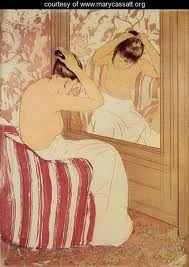


 I've just discovered the lovely work of American artist Ellen Heck. They remind me very much of the prints of Impressionist Artist, Mary Cassatt who I've been intending to write about for some time now. I have a beautiful catalogue from an exhibition of her prints at the National Portrait Gallery from a couple of years ago. Heck works with similar subtle colours to those that Cassatt favoured. Both have used simple figure drawings to depict intimate domestic scenes. There is also a similarity in the introduction of pattern in the textiles of both artists work. I can't help but be reminded of Japanese wood cut work in both their cases.
 Susan Stockwell produces beautifully crafted objects that you'd expect to see made out of textiles. For example, a Victorian dress complete with bustle made from Ordnance Survey maps which is entitled Empire Dress and a similar piece Trayne, is made from used coffee filters. These were produced to comment on British colonial history and are influenced by her own heritage. Other works are a mattress and quilt both made from recycled Mills & Boons books. Stockwell acknowledges that her attitude towards this genre was slightly altered by the process of working with, and reading, these books.


 I was reminded of Celia Birtwell's delicious textile designs last month, when looking for images from vintage Vogue magazines to publish. You can link to the posting here, if you'd like to view some classically appealing Norman Parkinson photographs, shot with his signature flare for fun. I especially loved the image below of Nicky Samuel modelling one of her prints in an Ossie Clark dress.


